 |
D3: A Global Technology
|
Currently, two prototype units exist. D3T built the original prototype, to demonstrate the effectiveness of the D3 technology. Consisting of a dashboard retrieved from a wrecking yard, a twenty-year-old breadboard, and less than $500 US in components, it effectively blocks all cell phone transmissions within a 20-meter radius. 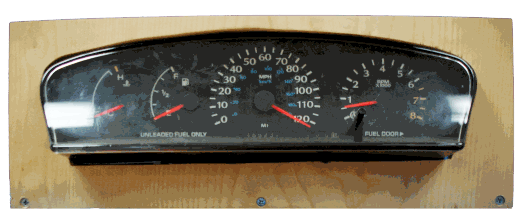 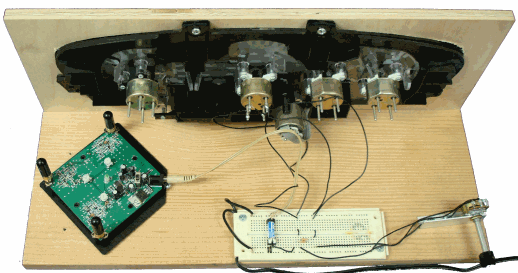 Original Prototype To refine the design and construct the second-generation prototype, D3T engaged the services of 360°RF. The result is a single printed circuit board containing both the signal generator and the antenna. This device is completely constructed from readily available "off the shelf"� components, making it simple and inexpensive to manufacture. This prototype is very small (1" x 2"�x 3/8"), allowing for installation in many locations inside the vehicle. Mounting this device perpendicular to a metal surface produces a directional field of emission. Measured at one meter, the field intensity of a device to the side or rear of the antenna is less than 1% of the strength of the forward field. The cost of manufacturing this device is approximately $8.51US in quantities of 100. As with all production, the costs reduce as quantities are increased. The estimated cost per unit for quantities of 100,000 or more is less than $2.00US. 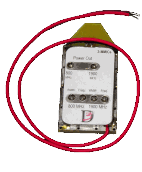 Second Generation Prototype In addition to simply developing a prototype, 360°RF agreed to do so using only the description portion of our patent filing, under NDA of course. Within eight weeks, a prototype was built, tested, and delivered to D3T, proving not only the technology, but also the US Patent and Trademark Office's requirement that the patents be able to be implemented "by someone skilled in the art"�. Details of the Current Prototype The D3 technology's most important feature is its ability to be restricted to the operator's area of the vehicle. The antenna design is crucial in making this happen. 360°RF developed three antenna prototypes, each with varying properties, to ensure that antenna production is simple, effective, and inexpensive. A technical description of the antenna follows. The antenna used in the current prototype is a Planar Inverted F-antenna (PIFA), the most promising of the designs. The circular design is omni-directional in free space, with only a few dB lower gain off the edges. The antenna shows desired responses from 850-950MHz, averaging about -10 to -12dB return loss. This equates to just under a 2-to-1 VSWR. Return loss is also -10dB at 1800MHz, rising to -8dB at 2100MHz, or just over a 2-to-1 VSWR. Antenna gain is roughly -24dBi at 860MHz, and -22dBi at 1900MHz in free space. While this may seem low, these numbers are typical of small format antennas. With an approximate 3dB gain from a ground plane reflection, and a +95dBuV signal, the antenna radiates an approximate +10dBm or 1/100W effective radiated power (ERP). When mounted perpendicular to a metal surface, the main lobe of the transmission is 90° to, or perpendicular to, that surface. Thus, mounting the antenna in reference to a metal ground plane concentrates the jamming energy around the operator. Many variables exist in determining the amount of jamming energy received in the passenger areas of the vehicle, including how the passenger holds their phone, which hand they hold it in, and the direction to the cell in use. Typically, passengers contend with jamming energy of about -15dB to -10dB (3% to 10%) of the jamming energy associated with the operator. Confinement of the signal to the equipped vehicle is high. Expected levels of radiation received by adjacent vehicles are -30dB to -40dB, or 0.1% to 0.01% of the signals in the operator's position. Design of the jamming circuit is also very important. Modulation of the jamming signal, as well as its power, is crucial to effective operation. Proper modulation allows lower transmission levels to achieve the same results as more powerful systems, particularly with digital signals. A technical description of the current jamming circuit follows. We optimized the current circuit design for CDMA (Code Division Multiple Access protocol) carriers, the most common carrier protocol in the US. It takes advantage of the low power Cell Site Pilot Carrier. In the spread spectrum world with processing gain, the target signal is not a simple continuous wave (CW) carrier. However, by interrupting this pilot carrier, mobile phones believe that cell sites are out of range. Presently, the Jammer puts out a sweep signal at a slightly higher rate than the CDMA packet rate. In this way, each data packet gets at least one "hit"� introduced by the Jammer. Resultantly, the mobile phone gets a packet with bit errors, which the phone interprets as cell sites being out of range. Depending on the "hits"� placement in the pseudo-code of the phone, it is statistically possible for a packet to arrive without bit errors, albeit very unlikely. The actual probability of this depends on several factors, including the jammer's and phone's mixers, the linearity of the phone's IQ demodulators, and the processing gain of the cell phone. The calculated probability of receipt of a cell packet without bit errors is approximately 1:1012. With analog and TDMA (Time Division Multiple Access protocol), the Jammer simply radiates enough power to prevent a mobile phone from working in all but the strongest signal locations (i.e. very near a tower). While we are not aware of any cell providers still using 800MHz TDMA, there may still be a few left out there. Despite the FCC requirement that cell providers maintain 800MHz analog systems (for emergency coverage, i.e. 911), very few phones manufactured today have this capability. In addition, the FCC requirement ends in 2010, and the analog equipment will come off-line very quickly as its maintenance is a multi-million dollar expense for cell phone providers today. Europe operates on different frequency bands, 900-960MHz and 1900-2200 MHz, along with a different modulation format, GSM. A European model would have limited effect on a US phone. However, the current design is tunable to the European frequencies via the six provided adjustment screws. A tested T-Mobile® GSM phone was jammed properly by the D3 device despite its optimization for CDMA signals. |
|
Copyright© 2007, D3T, LLC. |